
HOA & Zoning Compliance in Pasadena, CA
HOA and zoning compliance for an ADU in Pasadena means reconciling two separate rule sets: the City of Pasadena’s zoning code and your homeowners association’s Covenants, Conditions & Restrictions (CC&Rs) – and they don’t always agree. Most projects that stall between ADU Design & Permitting stall here, not at the building department. At Ellery ADU Studio Pasadena, we resolve both layers before a single drawing goes to print, so your project doesn’t sit in limbo while your HOA board convenes a meeting you weren’t invited to. Call us at (626) 427-9813 – a live person answers, no voicemail.
This page covers what HOA and zoning compliance actually involves on a Pasadena property, what it costs, and how it fits inside our broader ADU Design & Permitting in Pasadena process. If you already have a written estimate from someone else, we’ll give you a free second opinion on it – in writing, not over a phone call.
The short answer: in Pasadena, ADU zoning compliance under Title 17 of the municipal code requires meeting setback, height, lot coverage, and parking replacement rules specific to your zone. HOA approval – when required – runs on a separate track with its own timeline, typically 30 to 60 days. Handling both together, from the start, is the only way to avoid redesigning after the HOA rejects what the city already approved in your Permit Application.
When You Need HOA & Zoning Compliance
Not every Pasadena property has an HOA, but most of the neighborhoods where we work do – San Rafael Hills, Bungalow Heaven, Hastings Ranch, the streets east of Altadena Drive, and a good share of the condo-adjacent single-family parcels in South Pasadena-adjacent zones. If any of the following describes your situation, zoning and HOA compliance isn’t optional:
- Your property is governed by a homeowners association. Building an ADU without HOA approval – even one the city would permit – puts you at risk of a stop-work order, fines, or a forced removal. California Civil Code Section 4751 limits how far HOAs can go in blocking ADUs, but they retain authority over aesthetics, materials, and placement in many cases. We know where that line sits.
- Your lot is in a hillside or view-sensitive overlay district. Several parcels in the San Rafael Hills and upper Linda Vista corridor fall under Pasadena’s Hillside Development Standards, which impose steeper slope-setback requirements and stricter height limits than the base R-1 zone. A detached ADU that clears the standard code can still fail a hillside review if the design team didn’t catch the overlay.
- You’re converting a garage or adding to a structure near a property line. Garage conversion ADUs in Pasadena require a fire-separation analysis under the CBC and must meet the city’s setback minimums – typically three feet from a side or rear property line, though existing nonconforming structures have different rules. We confirm which applies to your specific parcel before we draw anything.
- Your neighborhood has a Historic Preservation Overlay Zone (HPOZ). Bungalow Heaven is a designated HPOZ. Additions and new structures visible from the street require a Certificate of Appropriateness from the Historic Preservation Commission before a building permit is issued. This step runs parallel to, not instead of, standard zoning review.
- A prior permit application was rejected or placed on hold. If your previous designer submitted drawings that came back with a zoning correction notice – for lot coverage, floor area ratio, or a setback encroachment – that’s a compliance failure that has to be corrected before resubmittal. We review the correction notice, identify what failed, and redesign to meet both the code and the city’s specific comments.
- You’re on a corner lot, a flag lot, or a lot with an easement. Corner lots in Pasadena trigger street-side setback rules that don’t apply to interior lots. Flag lot driveways count toward lot coverage calculations in ways that catch designers unfamiliar with Pasadena’s Title 17 off guard. Easements – utility, access, or view – can render otherwise buildable areas legally unusable for an ADU structure.
Our HOA & Zoning Compliance Process
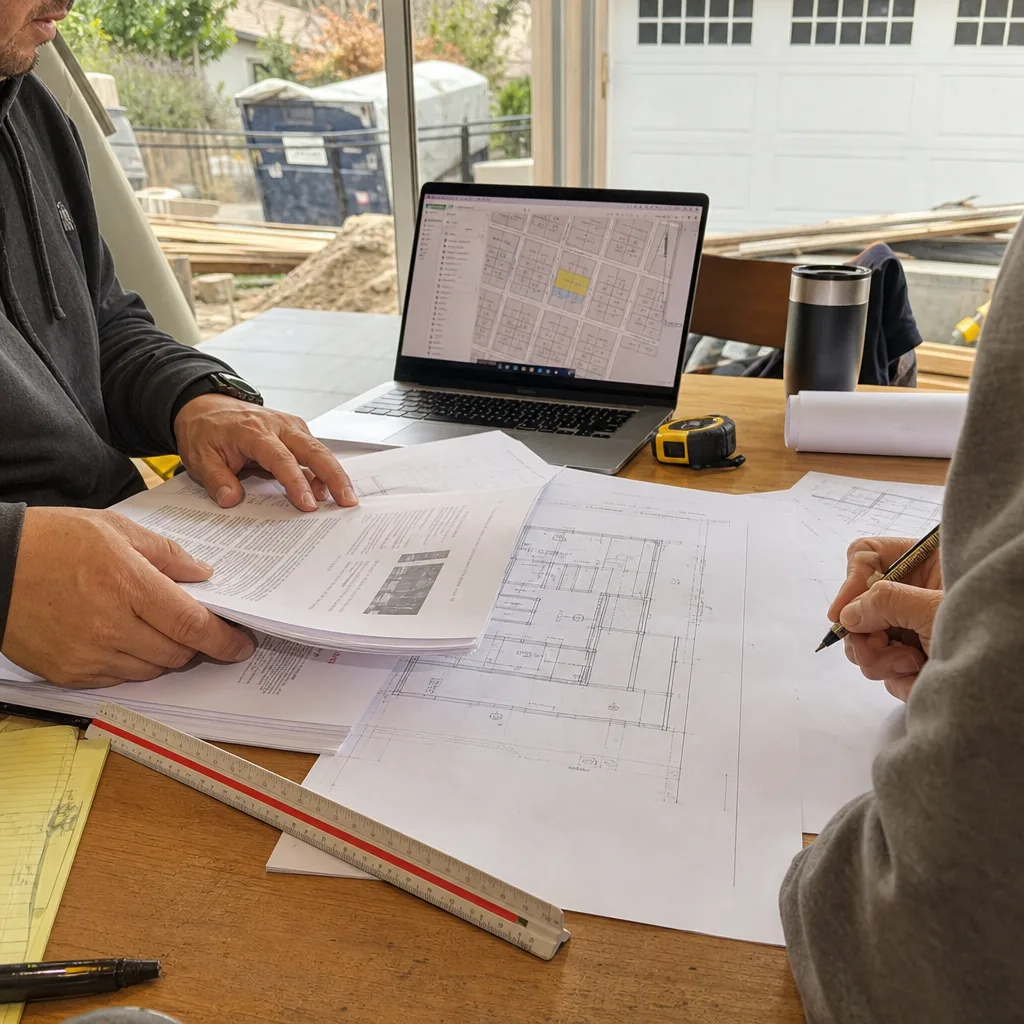
We handle compliance as a documented sequence, not a checklist someone runs through the night before submittal. Every step below produces something you can read and keep – not a verbal assurance.
- Parcel-level zoning audit. We pull the Assessor’s parcel data, confirm the base zone, and flag every overlay that applies: HPOZ, hillside, flood zone, fire hazard severity zone, utility easements. For properties in Pasadena’s R-1D or R-1-10,000 zones, the development standards differ from the standard R-1, and those differences affect what size ADU is feasible before we’ve drawn a line. This audit is written and included in your project file.
- CC&R and HOA governing document review. You give us the CC&Rs, the architectural guidelines, and any board resolutions your HOA has issued about ADUs. We read them – specifically for material restrictions, color restrictions, roofline rules, and any setback or height language that’s stricter than the city’s code. California SB 897 and AB 2221 (effective January 2023) narrowed what HOAs can prohibit, but the language your HOA actually uses matters. We document what they can and cannot require, so you go into the board meeting with a clear position.
- Compliance-first schematic design. The first sketch of your ADU is drawn to satisfy both the city code and the HOA’s enforceable restrictions simultaneously. If those two rule sets conflict – for example, if your HOA requires a specific roof pitch that would push the ADU over Pasadena’s 16-foot height limit for detached structures – we identify that conflict in writing before the schematic is finalized, and we propose the resolution. No surprises later. Under Haven Standard Clause 1, you have a written scope before any design work advances to construction documents.
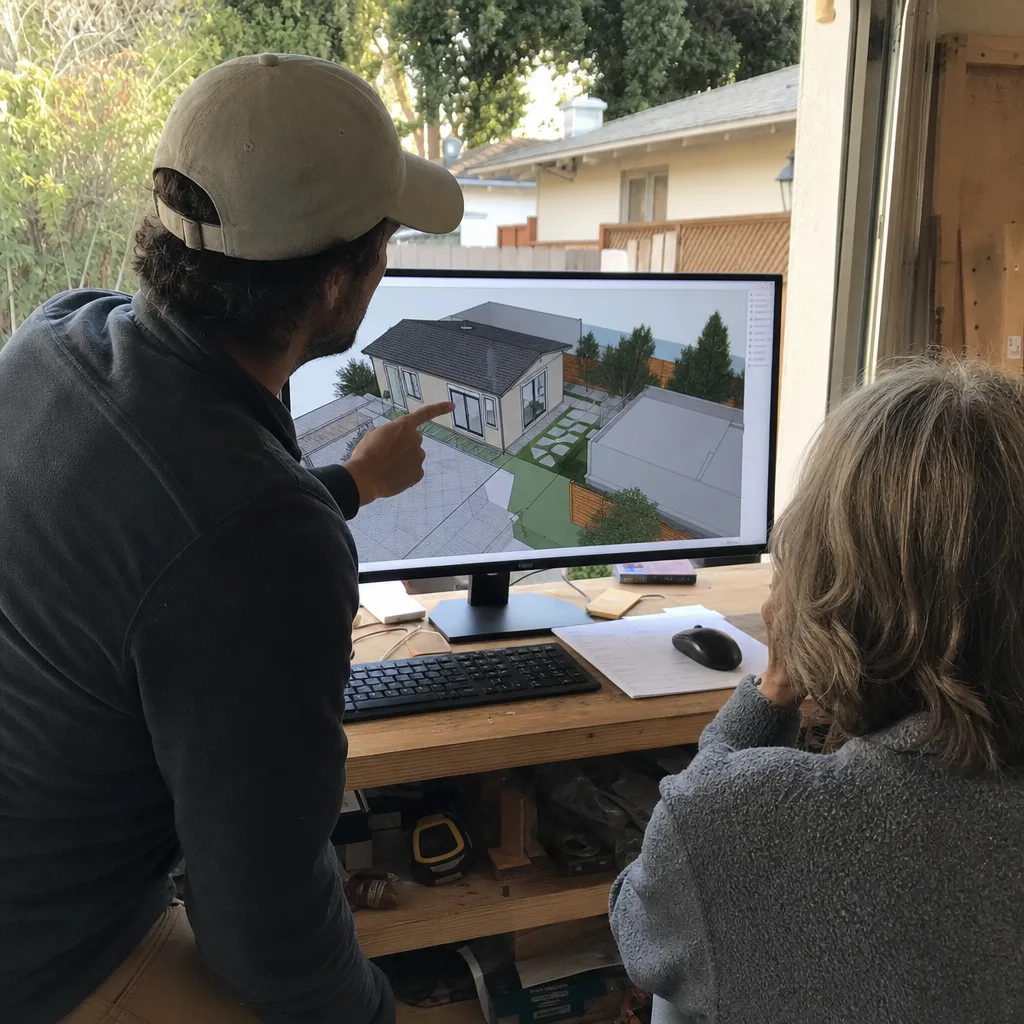
- HOA architectural application preparation. We prepare the HOA submission package: site plan, elevations, material specifications, and a narrative explaining how the design meets or exceeds the CC&R requirements. For projects using James Hardie fiber cement siding – which many Pasadena HOAs accept as a match for original wood lap siding on Craftsman and Colonial Revival homes – we include the product specification sheet so the architectural review committee has the technical data they need to approve, not just a description.
- City of Pasadena permit submittal coordination. We submit to the city’s Development Services Department and track the application through plan check. Pasadena uses an electronic plan check system; first-round corrections typically come back within 15 to 25 business days for ADU projects. We respond to correction letters directly – you don’t become the messenger between us and the plan checker. All correction responses are documented and added to your project file.
- Final compliance sign-off and permit issuance. When the city issues the permit and the HOA issues its approval letter, we confirm both documents are in hand before construction scheduling begins. Under the 365-Day Done Right Promise, if the finished structure isn’t built to the permitted drawings – the same drawings that satisfied both the city and the HOA – we make it right, in writing. That commitment is in your contract before we break ground.
HOA & Zoning Compliance Pricing in Pasadena
HOA and zoning compliance work in Pasadena is priced as part of the full ADU Design & Permitting scope – not as an add-on that appears after you’ve signed. Under Haven Standard Clause 1, you receive a written price before any work begins. Here’s what the compliance-specific work typically costs, as a line item within the full permit set fee:
- Zoning audit and parcel research: $400 – $800, depending on the number of overlays that apply and whether easement documentation requires a title search.
- CC&R and HOA document review: $300 – $600 for a standard CC&R package. If the HOA has issued supplemental ADU-specific board resolutions that require legal interpretation, that may add $200 – $400.
- HOA architectural application preparation: $600 – $1,200 for the submission package, including site plan, elevations, material specs, and narrative. Projects in Bungalow Heaven HPOZ, where the Certificate of Appropriateness application requires additional historic documentation, typically run at the higher end of this range.
- City of Pasadena plan check coordination and correction responses: $800 – $1,800, depending on the number of correction rounds. Projects with clean first-round submittals – which is what the compliance-first design process is built to produce – land near the low end.
- Full HOA + zoning compliance package (all of the above): typically $2,100 – $4,400 as a line item in the full ADU design and permit set quote.
What drives cost upward: HPOZ designation, hillside overlay, corner lot setback complexity, an HOA with outdated or ambiguous CC&Rs, and any property with an existing permit violation on record (which must be resolved before a new permit can issue). What keeps cost at the lower end: a standard R-1 lot with a clean permit history, a cooperative HOA, and a design that stays within the by-right ADU rules California’s state law now mandates cities honor, including Title 24 Energy Compliance.
All-in ADU projects in Pasadena – design, compliance, permitting, and construction under one contract – typically run $180,000 – $320,000 for a new detached ADU and $90,000 – $160,000 for a garage conversion, depending on size, site conditions, and finish level. The compliance work described on this page is included in that single written price, not invoiced separately after the fact.
If you have a written estimate from another firm, bring it. We offer a free second opinion – a written comparison, not a sales call.
FAQs – HOA & Zoning Compliance
Can my HOA legally block me from building an ADU in Pasadena?
No – California Civil Code Section 4751, strengthened by SB 897 effective January 2023, prohibits HOAs from enforcing CC&R provisions that effectively prohibit ADUs on a single-family lot. What HOAs can still do is enforce reasonable design standards: materials, colors, rooflines, and exterior finish that are consistent with the existing home or neighborhood character. In practice, this means your HOA can require James Hardie fiber cement in a specific color to match your main house, but it cannot require you to build a detached ADU at a height or setback that makes it economically unfeasible. We document exactly what your HOA’s CC&Rs can and cannot require before design begins, so you’re not negotiating blind at the architectural review meeting. Call us at (626) 427-9813 if you’d like us to walk through your specific CC&Rs before committing to a project scope.
What’s the difference between a zoning setback and an HOA setback requirement?
A zoning setback is the minimum distance the City of Pasadena’s Title 17 requires between your ADU and the property line – typically three feet from a rear or side line for a new detached ADU under state ADU law, though Pasadena’s code and hillside overlays can apply stricter standards in certain zones. An HOA setback in your CC&Rs is a private contractual rule that may require greater distance from an interior property line or from the main house itself. Both apply. When they conflict – and they occasionally do – state law governs the zoning minimum, but the HOA setback may still be enforceable as a private matter unless it triggers the “effectively prohibit” standard under Civil Code 4751. We identify any conflict in writing at the Site Assessment stage, before the design is locked.
How long does HOA approval take in Pasadena, and does it delay my permit?
Most Pasadena HOA architectural review committees meet monthly, which means a complete submission can take 30 to 60 days to receive a written approval letter. City of Pasadena plan check for an ADU typically runs 15 to 25 business days for a first-round review. We submit to both simultaneously where possible – the HOA submission and the city submittal can run on parallel tracks, not sequentially. In Bungalow Heaven HPOZ, the Certificate of Appropriateness process with the Historic Preservation Commission adds a separate review layer that can run 4 to 8 weeks depending on meeting schedules. We account for all of these timelines in the written project schedule you receive at contract signing, so the HOA calendar doesn’t catch you off guard three months in.
What happens if my HOA approves the design but the city plan checker requires a change?
This is exactly why compliance-first design matters. If a city correction letter requires a design change – say, a setback adjustment or a roof height reduction – that change has to go back to the HOA for sign-off before construction can begin on the modified element. We manage that loop: we prepare the revised HOA submission, document the city’s correction requirement as the reason for the change, and track the HOA response. Under the Haven Standard, scope changes triggered by agency corrections are documented in writing and don’t result in undisclosed cost increases. If you’re working with a designer who doesn’t build that loop into their process, you end up as the person chasing two agencies at once. Call (626) 427-9813 if you want to understand how this applies to a specific property you’re evaluating.
Why Pasadena Properties Require a Different Approach
Pasadena isn’t a uniform zoning jurisdiction. The city’s municipal code layers base zones (R-1, R-2, RM) under multiple overlay districts – historic preservation, hillside development, and specific plan areas like the East Pasadena Specific Plan – and each overlay carries its own development standards that can restrict or modify the by-right ADU rules that state law otherwise mandates. A project in the flat streets of South Pasadena-adjacent Madison Heights plays by different rules than a project on a steep lot above the 210 in San Rafael Hills, even if both are nominally R-1.
We’ve worked on ADU projects across Pasadena’s neighborhoods since Ellery ADU Studio’s founding in 2015 – the year California’s ADU permitting framework started shifting toward the owner-friendly rules we have today. In that time, we’ve seen the specific failure modes: the Bungalow Heaven project where the architect drew a flat roof the HPOZ would never approve, the Hastings Ranch garage conversion where a utility easement cut the buildable footprint by 40 square feet (enough to make a single-bedroom layout unworkable), the San Rafael Hills project where the hillside overlay required a geotechnical report that the original scope didn’t budget for.
For projects using prefab or modular systems – a Cover or Abodu unit, for example – HOA compliance adds a specific layer: the HOA’s architectural review committee needs the manufacturer’s elevation drawings, exterior finish specifications, and in some cases a site-specific rendering showing the unit in context. We coordinate that documentation directly with the manufacturer as part of the same single contract, so the HOA application is complete on first submission rather than going back and forth over missing product data.
Nadia Ellery and the studio team have navigated more than 900 ADU projects through design, permitting, and construction since 2015. Every one had a written price before work started and a documented photo record through completion. The compliance work described on this page is part of that same standard – not a side process managed by a permit expediter you’ve never met.
Key Takeaways
- Pasadena ADU projects require compliance with both city zoning (Title 17) and HOA CC&Rs – they run on separate tracks and must both be satisfied before construction begins.
- California law limits what HOAs can prohibit, but they retain authority over materials, colors, and rooflines – and some Pasadena HOAs still push those limits. Knowing the legal boundary before you go into a board meeting matters.
- HPOZ designation (Bungalow Heaven and others) adds a Certificate of Appropriateness requirement that runs parallel to standard permit review and typically adds 4 to 8 weeks.
- Hillside lots, corner lots, and parcels with easements carry zoning complications that standard R-1 compliance checklists miss.
- HOA and zoning compliance work is included in Ellery’s single written project price – not invoiced separately after the permit is pulled.
- Simultaneous submittal to the city and HOA compresses the approval timeline; sequential submittal is the slower and more common approach elsewhere.
Get a Written Quote – No Obligation
If you’re evaluating an ADU on a Pasadena property and aren’t sure whether your HOA CC&Rs or the city’s zoning overlay will create problems, the answer is to find out before you design anything. We do that work at the front of the project, in writing, as part of a fixed-price contract. Call (626) 427-9813 – a live person answers. Or bring a written estimate you’ve already received; our free second opinion compares it line by line, in writing. No obligation either way.
Written by Nadia Ellery, Owner at Ellery ADU Studio Pasadena, serving Pasadena.