
Title 24 Energy Compliance in Pasadena, CA
Title 24 energy compliance is a mandatory part of every permitted ADU in Pasadena. California’s Building Energy Efficiency Standards – commonly called Title 24 – require that every new dwelling unit, including accessory dwelling units, meet specific envelope, insulation, glazing, HVAC, and water-heating thresholds before the city issues a building permit. Without a compliant energy report stamped by a certified HERS rater and accepted by the Pasadena Building and Safety Division, your project stalls – sometimes for weeks.
At Ellery ADU Studio, Title 24 compliance is built into the permit set from the first site assessment, not added on as a last-minute line item. If you’re starting an ADU project and want to understand exactly what the process covers and what it costs, call us at (626) 427-9813 – a live person answers. This page is part of our broader ADU Design & Permitting in Pasadena practice, which covers everything from site feasibility through final inspection under one written contract.
Nadia Ellery founded this studio in 2015, the same year California’s ADU exemption rules shifted meaningfully, and since then the team has produced energy compliance documentation on more than 900 ADU projects. That volume matters because Title 24 calculations are not generic: they depend on the orientation of the structure on the lot, the local climate zone, the glazing-to-floor-area ratio, and the mechanical systems specified. Getting those inputs wrong means a rejected report and a restart.
When You Need Title 24 Energy Compliance
- You’re pulling a permit for any new ADU in Pasadena. The Pasadena Building and Safety Division requires a California Energy Commission-compliant CF1R report as part of every residential permit submittal. There is no exemption for small ADUs under the current 2022 Energy Code cycle, which remains in effect through 2025-2026 enforcement.
- Your garage conversion involves adding conditioned space. Converting an attached or detached garage in Bungalow Heaven, Daisy Villa, or Madison Heights into a livable ADU changes the thermal envelope of the structure. That triggers a full Title 24 envelope and mechanical analysis – not just an insulation note on the plans.
- You’re installing a new mini-split, heat pump, or water heater. Any change to the mechanical systems in a permitted ADU requires the equipment to be sized and specified to meet minimum efficiency ratings under Part 6 of the California Building Code. An undersized heat pump water heater on a north-facing unit in Pasadena’s Climate Zone 10 is a common correction we see during plan check.
- Your ADU drawings have been sitting in plan check and the city has flagged an energy note. Plan check comments from the City of Pasadena frequently cite insufficient insulation values, non-compliant window U-factors, or missing HERS verification requirements. These corrections require a revised CF1R, not just a note response.
- You’re working with a prefab or modular unit and need compliance documentation. Prefab suppliers like Abodu and Cover produce units pre-engineered to California Energy Code, but the site-specific installation still requires a location-adjusted energy compliance report tied to your specific Pasadena parcel, orientation, and utility provider (Southern California Edison, in most cases).
- Your project is a junior ADU or interior conversion and you assumed compliance wasn’t required. JADU projects that create new conditioned space or alter the mechanical system do require energy documentation, even when they’re carved out of existing square footage. We see this misunderstanding regularly in older Craftsman and Spanish Colonial homes in the Prospect Park and South Lake neighborhoods.
Our Title 24 Energy Compliance Process
-
Site Assessment and Climate Zone Confirmation
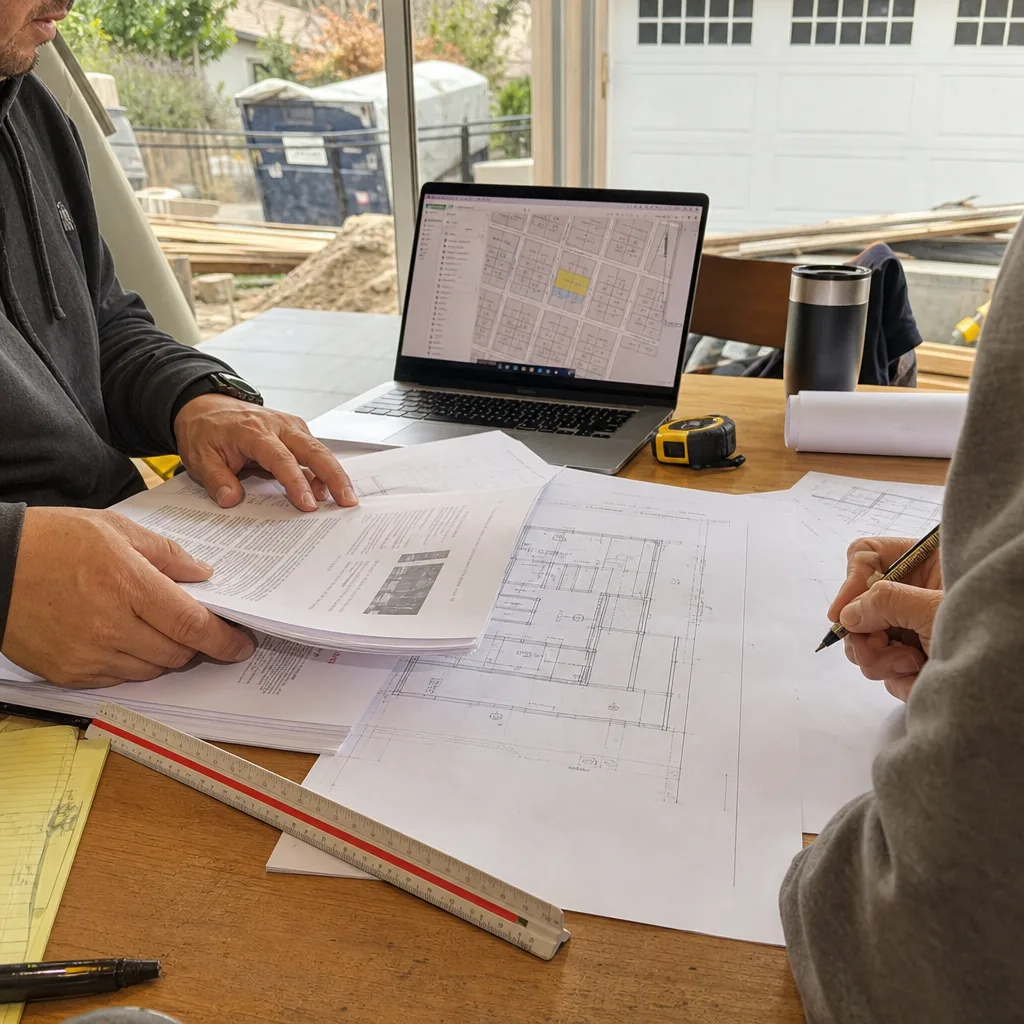
Pasadena sits in California Climate Zone 10, which carries specific heating and cooling load assumptions that affect every calculation downstream. We start by confirming the parcel address against CEC climate zone maps and pulling the utility rate schedule from Southern California Edison. We also note the lot orientation, any significant shading from mature trees or adjacent structures (common on the tighter lots in Madison Heights and Bungalow Heaven), and the planned ADU footprint. These inputs feed directly into the energy model – and a 15-degree difference in solar access can change the glazing compliance path significantly.
-
Energy Model and CF1R Report Generation
We run the compliance model using CEC-approved software. The output is a CF1R – the performance compliance form that becomes part of your permit set. The model accounts for wall and ceiling insulation R-values, window U-factor and solar heat gain coefficient (SHGC), mechanical equipment efficiency ratings, duct leakage allowances, and water heating system type. For most Pasadena ADUs under 1,000 square feet, a standard prescriptive compliance path is feasible. Larger units or those with significant glazing (popular in new detached ADUs designed with a James Hardie lap siding and large western-facing windows) sometimes require a performance path, which takes a bit longer to model but can give more flexibility in the design.
-
Integration Into the Full Permit Set
The CF1R and supporting energy notes are embedded directly into the permit drawings – they are not a separate submittal that arrives days later from a third-party consultant. Under the single-contract model at Ellery ADU Studio, the energy compliance documentation and the ADU Design & Blueprints are produced together, which eliminates the coordination gap that causes most plan check delays. Under Haven Standard Clause 1, the full scope including the energy compliance package is quoted in writing before any work begins. No surprises at the permit counter.
-
City of Pasadena Plan Check Coordination
The Pasadena Building and Safety Division reviews ADU permits on a standard queue, with over-the-counter review available for certain small projects. Our permit coordinator tracks the submittal status and responds to any plan check corrections within the city’s allotted correction window. Energy-related corrections – the most common being glazing area overages or missing duct sealing notes – are resolved without additional fees to you, per the written scope agreed at the start.
-
HERS Field Verification and CF2R/CF3R Documentation
After construction, a certified Home Energy Rating System (HERS) rater must perform field verification of the installed insulation, window labels, duct leakage, and mechanical equipment. This produces the CF2R (installer certificate) and CF3R (HERS rater certificate) required for final inspection sign-off. Ellery ADU Studio coordinates the HERS rater as part of the project close-out. These documents go into the project photo record, which the client receives as a permanent file under the Haven Standard documentation commitment.
-
Final Inspection and Certificate of Occupancy
Title 24 compliance is a gate item at final inspection. The Pasadena inspector will verify that the installed systems match the approved CF1R and that the HERS certificates are on file. Because our energy model is built from the actual specified materials and equipment – not a generic placeholder spec – the final inspection rarely surfaces a discrepancy. When the ADU is built to the permitted drawings, the 365-Day Done Right Promise covers it: if something is not built to the drawings, Ellery makes it right in writing.
Title 24 Energy Compliance Pricing in Pasadena
Title 24 energy compliance in Pasadena typically costs between $600 and $1,800 as a standalone service, depending on the complexity of the unit and whether the compliance path is prescriptive or performance-based. For a detailed breakdown, see our guide on How Much Does ADU Design & Permitting Cost? (2026 Price Guide) - Pasadena, CA. When it’s part of the full Ellery ADU Studio design-build contract – which is how most of our clients structure the project – it is included in the permit set deliverable and does not appear as a separate add-on line item.
Here’s what drives cost on the compliance side:
- Unit size and configuration: A 400-square-foot studio JADU in South Pasadena has a simpler energy model than a 1,200-square-foot two-bedroom detached ADU with a dedicated HVAC system and a custom glazing package.
- Prescriptive vs. performance path: The prescriptive path uses fixed compliance tables and is faster to document – typically on the lower end of the range. The performance path requires a full energy simulation, which takes more time but can accommodate design choices (larger windows, a specific mechanical system) that wouldn’t clear the prescriptive tables.
- Number of plan check correction rounds: Projects that arrive at our studio with existing incomplete drawings from another designer sometimes require the energy model to be rebuilt from scratch. We price that work transparently before touching the file.
- HERS verification coordination: Field verification by a certified HERS rater typically adds $350 to $600 to the project close-out cost. This is not optional – it is a City of Pasadena requirement. We include it in the project scope so the number is visible before you sign.
- Expedited plan check: Pasadena Building and Safety offers an expedited review option for an additional city fee. When a client’s timeline makes that worthwhile, we coordinate it and pass the city’s fee through at cost, no markup.
Every project receives a written price before any work begins – Haven Standard Clause 1, no exceptions. If you have a written estimate from another design firm or contractor already in hand, we’ll review it at no charge and tell you exactly what it does and doesn’t cover on the energy compliance side. Call (626) 427-9813 to set that up.
FAQs – Title 24 Energy Compliance
Is Title 24 energy compliance required for all ADUs in Pasadena?
Yes – every permitted ADU in Pasadena that creates new conditioned space requires a Title 24-compliant energy report (CF1R) as part of the building permit submittal. This applies to new detached ADUs, garage conversions, junior ADUs that alter the thermal envelope or mechanical systems, and additions to existing structures. The only narrow exception is a JADU that makes no changes to the mechanical system and no changes to the insulation or windows – but in practice, most JADU projects in Pasadena do touch at least one of those elements. California’s 2022 Building Energy Efficiency Standards are the current applicable code as of this writing. Call us at (626) 427-9813 if you want a straight answer on whether your specific project triggers a full compliance report.
What is a HERS rater and why does Pasadena require one?
A Home Energy Rating System (HERS) rater is a third-party field verifier certified by the California Energy Commission. Their job is to confirm that what’s installed in the finished ADU actually matches what the energy model specified on the approved CF1R. They check insulation installation quality, window label U-factor and SHGC values, duct leakage, and mechanical equipment model numbers. Pasadena Building and Safety requires the HERS rater’s field certificate (CF3R) before issuing a final inspection sign-off. Without it, you cannot get a Certificate of Occupancy. Ellery ADU Studio coordinates the HERS rater appointment as part of the construction close-out – the client doesn’t have to source one independently.
Can the energy compliance report be added after the drawings are done?
Technically yes, but it creates real problems. The energy model depends on the window sizes, orientations, wall assembly types, and mechanical specifications shown on the drawings. If those decisions are made without the energy compliance analysis in the loop, the drawings often have to be revised – sometimes significantly – to pass compliance. We see this regularly when clients bring us drawings that another designer completed without integrating the energy model. The correction process takes time and costs money. Building the compliance analysis into the drawings from the start, which is how Ellery ADU Studio structures every project, avoids that backtrack entirely.
Does Title 24 compliance affect what materials or equipment I can choose?
Yes, in specific ways – but the compliance path is more flexible than most homeowners expect. The prescriptive compliance tables set minimum R-values for walls and ceilings, maximum U-factors and SHGC ratings for windows, and minimum efficiency ratings for HVAC and water heating equipment. If a design calls for larger windows on a west-facing wall, or a particular aesthetic that affects the thermal envelope, we run the performance path instead, which allows trade-offs between components as long as the whole-building energy budget is met. For example, a detached ADU with a James Hardie fiber cement exterior and substantial south-facing glazing can often still comply on the performance path by specifying a heat pump water heater and a high-efficiency mini-split. The key is knowing which path to use before the design is locked – not after.
Why Ellery ADU Studio on Title 24 in Pasadena
Pasadena is not a simple ADU Design & Permitting services environment. The city’s design review requirements in historic neighborhoods like Bungalow Heaven and Prospect Square, combined with California’s increasingly detailed energy code, mean that the permit set has to be tight from the first submittal. A loose energy note or a placeholder mechanical spec gets flagged in plan check, and that flag costs time you didn’t budget.
Since 2015, Nadia Ellery and the studio team have taken more than 900 ADU projects from initial feasibility through final inspection, every one with a written price before work started and a documented file when it was done. If you’re searching for ADU Design & Permitting Near Me in Pasadena, CA, our studio is based here and works exclusively on local projects. The energy compliance report is not an afterthought here – it’s one of the core deliverables in the permit set, produced alongside the architectural drawings by the same team that will be on site when the walls go up.
That single-contract structure matters more than it might sound. When the designer and the builder are the same entity on the same contract, nobody can point at the other party when the HERS rater finds that the installed insulation doesn’t match the spec. The 365-Day Done Right Promise is in writing before the project starts: if the finished ADU is not built to the permitted drawings, Ellery makes it right. That’s not a marketing line – it’s in the contract.
If you’re working through a full ADU project in Pasadena and want to understand exactly what the energy compliance piece involves for your specific lot, unit type, and design goals, the conversation starts with a written price – not a vague range and a callback. Call (626) 427-9813. A live person will answer, and if you already have a written estimate from another firm, we’ll give you a free second opinion on what it covers.
Written by Nadia Ellery, Owner at Ellery ADU Studio Pasadena, serving Pasadena.